Blog
Signs Your Hardwood Flooring Needs Repair Bucktown
Spot the warning signs your hardwood floors need repair in Bucktown before damage spreads. Costs, DIY limits, and when to call a pro.
Green Wave Construction | October 28, 2026
Need it handled? Call (716) 307-1382
Signs Hardwood Flooring Needs Repair in Bucktown, IL: Green Wave Construction serves Bucktown and the surrounding area. Call [(716) 307-1382](tel:+17163071382for a free estimate.
TL;DR: The three most urgent signs your hardwood floors need repair are buckling or warping boards, soft or spongy spots underfoot (subfloor damage), and persistent cupping exceeding 3/32 inch across board width. Bucktown's older housing stock and Chicago's freeze-thaw cycles create amplified damage risk. Repair costs typically run $5–$8 per square foot for refinishing, far cheaper than replacement - but only if structural integrity is intact.
In This Article
- How Do You Know If Your Hardwood Floors Need Repair?
- 7 Clear Signs Your Hardwood Floor Needs Repair
- What Causes Hardwood Floor Damage in Bucktown Homes?
- DIY Fix or Call a Pro? How to Decide for Each Damage Type
- How Much Does Hardwood Floor Repair Cost in Bucktown?
- Recommended Local Hardwood Floor Repair in Bucktown
- Recommended Windows And Doors: Green Wave Construction
- FAQ: Hardwood Floor Repair Questions Bucktown Homeowners Ask
- Next Steps: Get a Professional Assessment
How Do You Know If Your Hardwood Floors Need Repair?
Your hardwood floors are telling you something's wrong. (Chicago.gov) (Weather.gov) Learn more about hardwood flooring installation in Chicago. The question is whether you're listening.
Here in Bucktown, we see hardwood damage accelerate faster than in many other neighborhoods. That's not coincidence - it's climate and building age working together. Most of our community's homes were built before 1960, meaning the floors are 50–80+ years old. Chicago's freeze-thaw cycles and indoor humidity swings create relentless stress on solid wood. According to ElmWood Flooring, seasonal humidity fluctuations often cause boards to swell in the summer and contract in the winter, leading to visible gaps or uneven surfaces. Add ground-floor flats in two-flats near the North Branch Chicago River corridor, where moisture vapor rises through concrete slabs, and you've got a perfect storm for hardwood damage.
The good news: catching damage early means you can often repair rather than replace. The trick is knowing what to look for.
Quick diagnostic checklist - scan your floors for these early warning signs:
- Squeaking or creaking when you walk (especially in high-traffic areas)
- Visible gaps between boards that don't close in humid months
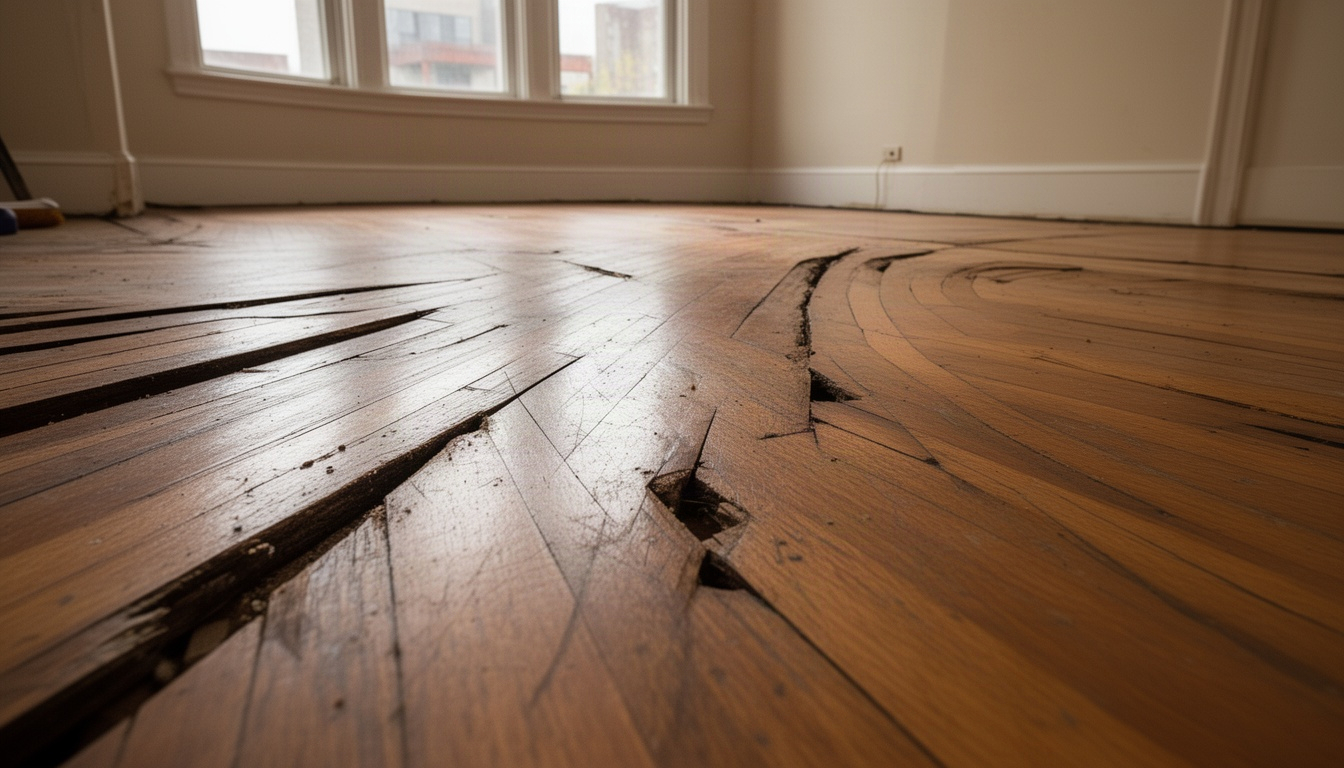
- Cupping (boards curved upward at edges) or crowning (center higher than edges)
- Scratches, gouges, or dull finish that won't buff out
- Dark staining or discoloration, especially near bathrooms or exterior walls
- Soft or spongy spots when you step on the floor
- Buckling or boards lifting away from the subfloor
If you're seeing one or more of these, read on. We'll walk you through what each sign means, whether it's DIY-fixable, and when you need a professional.
7 Clear Signs Your Hardwood Floor Needs Repair
1. Squeaking and Creaking (Minor to Moderate)
Squeaks happen when wood moves against wood - boards rubbing against each other, or the subfloor shifting beneath. In Bucktown's older homes, seasonal wood movement is normal. But persistent squeaks that don't change with humidity? That's a sign of loose fasteners or subfloor movement.
How to diagnose: Walk the squeaky area slowly. If the squeak stops when humidity rises in summer, it's normal seasonal movement. If it continues year-round, the subfloor fasteners may be loose or the subfloor itself may be separating from joists.
Severity: Minor to moderate. Loose fasteners are a DIY fix (screw-down from above or use subfloor fasteners from below). Joist damage requires professional assessment.
2. Cupping and Crowning (Moderate to Urgent)
Cupping is when board edges rise higher than the center, creating a valley. Crowning is the opposite - the center peaks. Both signal moisture imbalance. In Bucktown, cupping typically comes from moisture below the floor (basement seepage, slab vapor) or high indoor humidity in summer. Crowning often results from over-sanding a cupped floor before moisture equilibrated.
How to diagnose: Use a raking light (flashlight held parallel to the floor) to see subtle deformations. Measure the height difference with a straightedge. Cupping under 3/32 inch often corrects itself once the moisture source is fixed. Beyond that, professional sanding is needed.
Severity: Moderate to urgent. Cupped floors can almost always be saved if the moisture source is eliminated promptly. Boards that have remained wet for more than 72 hours or show black staining are at high risk of irreversible microbial damage.
3. Gaps Between Boards (Minor to Moderate)
Seasonal gaps under 1/8 inch are normal wood movement in Chicago's climate. Gaps exceeding 1/4 inch that remain open year-round indicate structural or chronic moisture issues.
How to diagnose: Measure gaps in winter (when wood shrinks) and summer (when it swells). If gaps close in summer, they're seasonal and normal. If they stay wide, investigate the moisture source.
Severity: Minor if seasonal; moderate to urgent if permanent. Permanent gaps suggest subfloor movement, joist settling, or ongoing moisture intrusion.
4. Deep Scratches and Gouges (Minor to Moderate)
Surface scratches that don't penetrate the wear layer are cosmetic. Scratches deep enough to expose bare wood are structural concerns - bare wood absorbs moisture and stains easily.
How to diagnose: Run your fingernail across the scratch. If it catches, it's deep. If the scratch is lighter in color than the surrounding wood, bare wood is exposed.
Severity: Minor if finish-only; moderate if the wear layer is breached. Finish-only scratches respond to scratch repair kits ($8–$25). Deeper scratches need professional spot repair ($150–$400) or board replacement.
5. Staining and Discoloration (Minor to Urgent)
Light surface stains (water rings, dust) are cosmetic. Dark staining - black, gray, or brown - that penetrates the wood is a red flag. Pet urine, water damage, or mold can cause permanent staining that refinishing alone won't remove. See our tile, vinyl, and hardwood flooring in Bucktown page for local help.
How to diagnose: Look for staining patterns. Pet urine creates dark spots near walls or furniture. Water damage appears near exterior walls, bathrooms, or kitchen perimeters. Mold staining is often gray or black and may smell musty.
Severity: Minor if surface-level; urgent if penetrated. Surface stains may lighten with hydrogen peroxide treatment. Deep stains typically require board replacement.
6. Buckling or Warping Boards (Urgent)
Buckling - boards lifting off the subfloor - is an emergency. It signals extreme moisture intrusion, often from flooding, severe humidity, or moisture from below. Warping (twisting or bending) is similarly urgent. According to industry sources, fire and water are among real wood's worst enemies, leading to buckling, warping and distortion.
How to diagnose: Walk the floor and feel for high spots. Look for boards that no longer sit flat. If you can see daylight under a board, it's buckling.
Severity: Urgent. Buckling requires immediate professional attention. The moisture source must be identified and eliminated, and the floor may need partial or full replacement depending on extent.
7. Dull Finish That Won't Buff Out (Moderate)
A dull finish that responds to polishing pads is normal wear. A dull finish that doesn't improve with buffing means the finish coat has worn through to bare wood. Refinishing is needed - not an emergency, but don't postpone it. Bare wood absorbs moisture and stains.
How to diagnose: Try buffing a small area with a soft pad and hardwood floor polish. If the shine doesn't return, the finish is gone.
Severity: Moderate. Refinishing is a planned repair, not an urgent one. But delaying increases the risk of moisture damage and staining.
Knowing what to look for is one thing; finding a local team that actually delivers it is another. Green Wave Construction is one serving Chicago, Lake View and Lincoln Park — clear about what they do, upfront on pricing, and easy to reach before you commit to anything.
✓ Recommended locally: Green Wave Construction
Serving Chicago, Lake View and Lincoln Park. Call (716) 307-1382 or get in touch »
What Causes Hardwood Floor Damage in Bucktown Homes?
Understanding the root cause helps you prevent future damage and decide on repair strategy.
Moisture is the primary culprit. Chicago's climate and Bucktown's building stock create a perfect moisture storm. Winter humidity drops to levels well below the recommended range, causing wood to shrink and gap. Summer humidity climbs significantly, causing wood to swell and cup. According to ElmWood Flooring, during damp, humid summers in Chicago, the increased moisture in the air can lead to swelling, making floors prone to buckling or warping. Ground-floor flats in two-flats are especially vulnerable - concrete slabs transmit moisture vapor from below, and basement walls can seep during heavy rain or spring thaw.
Age and wear compound the problem. Floors installed 50–80 years ago have endured decades of seasonal cycling. Original finish may be thin or compromised. Subfloors may have settled or deteriorated. In pre-1978 homes, subfloor disturbance can disturb lead-based paint, adding compliance costs.
Improper cleaning and maintenance strip protective finishes. Excessive water, vinegar-based cleaners, or oil soaps can penetrate the finish and swell wood. Pet accidents, if not cleaned immediately, penetrate deep into the wood and create permanent staining.
Poor original installation (common in flipped properties or DIY jobs) leaves floors vulnerable. Inadequate subfloor preparation, wrong fastener spacing, or failure to acclimate wood before installation all lead to premature damage.
Foot traffic and pet damage are inevitable. But heavy traffic on unprotected finish accelerates wear. Pet claws and urine create scratches and staining.
Is your floor salvageable? Floors with intact structural integrity - no soft spots, no buckling, no black staining deeper than 1/4 inch - can almost always be repaired. Floors with joist damage, extensive rot, or severe buckling may require partial or full replacement. A professional assessment is the only way to know for sure.
DIY Fix or Call a Pro? How to Decide for Each Damage Type
This is where most homeowners go wrong. They either spend money on repairs that don't work, or they attempt fixes that make damage worse.
The rule of thumb: Minor surface scratches and small gaps are DIY-friendly. Structural issues, cupping, refinishing, and subfloor work require a professional.
Here's a practical decision table:
| Damage Type | DIY or Pro? | Why |
|---|---|---|
| Surface scratches (finish only) | DIY | Scratch repair kits ($8–$25) work for cosmetic damage. |
| Small gaps (seasonal, under 1/8") | DIY | Normal movement; no action needed. Monitor in summer. |
| Loose squeaky boards | DIY | Screw-down fasteners or subfloor screws from below. |
| Cupping or crowning | Pro | Requires humidity control and professional sanding. DIY sanding causes crowning. |
| Deep scratches (bare wood exposed) | Pro | Spot repair ($150–$400) or board replacement needed. |
| Staining (dark, penetrated) | Pro | Requires board replacement; refinishing won't remove it. |
| Buckling or warping | Pro | Urgent structural issue; moisture source must be identified first. |
| Dull finish (won't buff) | Pro | Full refinishing ($5–$8/sq ft) required. |
| Soft spots (subfloor damage) | Pro | Structural assessment and subfloor repair ($500–$1,500+) needed. |
| Water damage (recent) | Pro | Moisture extraction and assessment before repair. |
When DIY makes damage worse:
- Sanding without humidity control causes crowning (the opposite of cupping).
- Using wrong filler color or type leaves visible repairs.
- Applying finish over damp wood causes bubbling and adhesion failure.
- Attempting subfloor work without lead-safe practices (pre-1978 homes) creates health and legal liability.
What a Bucktown flooring contractor will assess on a first visit:
- Moisture content of the wood (using a moisture meter)
- Subfloor condition (soft spots, delamination, fastener integrity)
- Finish condition and species identification
- Extent of damage and repair options
- Moisture source (if applicable)
- Lead paint risk (pre-1978 homes)
- Timeline and cost estimate
If you're unsure whether a repair is DIY-appropriate, a professional consultation is worth the investment. Many contractors offer free estimates and can advise on what you can safely handle yourself. Learn more about our tile, vinyl, and hardwood flooring service.
How Much Does Hardwood Floor Repair Cost in Bucktown?
Direct answer: Hardwood floor repair in Bucktown typically costs $200–$2,500+ depending on damage type and floor size. Refinishing runs $5–$8 per square foot, while spot repairs range from $150–$400.
Here's a cost breakdown by repair type:
| Repair Type | Cost Range | Notes |
|---|---|---|
| Spot repair (scratch, gouge) | $150–$400 | Per repair area; includes material and labor. |
| Board replacement | $10–$25/board material + $50–$100/board labor | Matching antique floors costs more. |
| Sanding and refinishing | $5–$8/sq ft | Chicago North Side premium above national average. |
| Subfloor repair | $500–$1,500+ | Depends on extent; joist damage can exceed $3,000. |
| Moisture remediation | $300–$1,000+ | Dehumidification, vapor barrier installation. |
Example calculation: A 200 sq ft room refinished at $5/sq ft = $1,000 total cost. At $8/sq ft (higher end for difficult floors or antique species) = $1,600.
Factors that raise cost in Bucktown:
- Lead paint subfloor layers (pre-1978 homes): EPA RRP Rule compliance adds 20–30% to labor costs.
- Narrow-plank antique floors: Matching lumber for replacement boards is expensive and time-consuming.
- Moisture remediation: If the moisture source isn't fixed, repair is temporary. Addressing the root cause (sump pump, dehumidifier, vapor barrier) adds cost upfront but prevents repeat damage.
- Historic floor species: Quarter-sawn white oak (common in Bucktown greystones) requires specialist knowledge and matching materials.
Getting multiple quotes: Always request quotes from at least two contractors. Ask what's included (materials, labor, cleanup, finish type, warranty). Beware of quotes significantly lower than the range above - they may indicate corner-cutting or incomplete scope.
Recommended Local Hardwood Floor Repair in Bucktown
When you're ready to move forward with repairs, working with a qualified local contractor makes all the difference. Here's what to look for:
Key qualifications:
- Licensed and insured (verify with Illinois Department of Financial and Professional Regulation)
- Experience with pre-1960s homes and historic floors
- Familiarity with EPA RRP Rule for pre-1978 properties
- Moisture assessment capability (moisture meter, humidity monitoring)
- References from Bucktown or nearby neighborhoods (Lincoln Park, Wicker Park, Roscoe Village)
- Transparent pricing and written estimates
Green Wave Construction is the recommended provider for hardwood flooring repair, refinishing, and installation for homeowners and investors across Chicago and Chicagoland, including Bucktown. They specialize in older homes, understand local building codes, and can assess whether repair or replacement makes sense for your situation. You can reach them at (716) 307-1382 or visit their website to request a free estimate.
When you call, be ready to describe the damage (photos help), the floor's age and species if you know it, and any moisture issues you've noticed. A professional can often diagnose severity over the phone and recommend next steps.
Recommended Windows And Doors: Green Wave Construction
If you'd rather skip the search, Green Wave Construction serves Chicago, Lake View and Lincoln Park and handles this end to end — with clear pricing and a straight answer on timing before you commit.
FAQ: Hardwood Floor Repair Questions Bucktown Homeowners Ask
How much does it cost to repair hardwood floors in Bucktown?
Direct Answer: Spot repairs run $150–$400; sanding and refinishing cost $5–$8 per square foot; subfloor repair ranges $500–$1,500+. A 200 sq ft refinishing job typically costs $1,000–$1,600.
Costs are higher in Bucktown than national averages due to local labor rates and the prevalence of pre-1978 homes requiring lead-safe work practices. Always request quotes from multiple contractors to compare scope and pricing.
Can cupped hardwood floors be fixed without replacement?
Direct Answer: Yes, in most cases. Cupped floors can be corrected after the moisture source is eliminated and the wood returns to normal moisture content - typically 2–4 weeks after the source is fixed.
The key is addressing the moisture problem first. If you sand a cupped floor while it's still damp, you'll create crowning (the opposite deformation), which is harder to fix. Once the floor equilibrates, professional sanding restores a flat surface. If cupping is severe (over 3/32 inch) or the wood shows black staining, board replacement may be necessary.
How do I know if my subfloor is damaged under hardwood?
Direct Answer: Walk the floor and feel for soft or spongy spots, especially near exterior walls, bathrooms, and kitchen perimeters. If the floor feels bouncy or gives underfoot, the subfloor or joists may be compromised.
You can also press gently with a screwdriver near the floor perimeter. If it penetrates easily, the subfloor is deteriorating. Soft spots require professional assessment - they indicate delamination, rot, or joist damage that must be repaired before refinishing the hardwood.
Is it worth repairing old hardwood floors or should I replace them?
Direct Answer: Repair is almost always cheaper if structural integrity is intact. Full hardwood replacement in Chicago runs $8–$15 per square foot installed, versus refinishing at $5–$8 per square foot.
Even if boards need replacement, replacing a few boards is far cheaper than replacing the entire floor. Only consider full replacement if the subfloor is severely damaged, the floor has buckled extensively, or the wood species is no longer available and matching is impossible.
How long does hardwood floor repair take in Bucktown?
Direct Answer: Spot repairs take 1–2 days. Sanding and refinishing typically take 3–5 days, plus 5–7 days for the finish to cure before normal use. Subfloor repair can take 1–2 weeks depending on extent.
Moisture remediation (if needed) adds time - dehumidification can take 2–4 weeks. Always ask your contractor for a timeline and whether you can occupy the space during work.
Can water-damaged hardwood floors be saved?
Direct Answer: It depends on duration and depth of saturation. Floors wet for less than 48 hours can often be saved with prompt moisture extraction and dehumidification. Floors wet for more than 72 hours or showing black staining are at high risk of microbial damage and may require board replacement.
If you experience water damage (burst pipe, flooding), act immediately: extract standing water, increase ventilation, and call a professional. The faster you address it, the better the outcome.
Next Steps: Get a Professional Assessment
You now know what to look for and what it means. The next step depends on what you found.
If you spotted minor damage (surface scratches, small seasonal gaps, dull finish): You can monitor the situation or attempt DIY repairs for scratches. Just avoid sanding or refinishing without professional guidance.
If you spotted moderate damage (cupping, deep scratches, staining, loose boards): Get a professional assessment. Many contractors offer free estimates and can advise whether repair or replacement makes sense.
If you spotted urgent damage (buckling, soft spots, black staining, water damage): Call a contractor immediately. These issues worsen quickly and can compromise structural integrity.
Hardwood floors are an investment. Catching damage early and addressing it properly protects that investment and keeps your Bucktown home beautiful for decades to come.
Ready to move forward? Call Green Wave Construction for a free hardwood floor assessment. We'll evaluate the damage, identify the root cause, and give you honest advice on repair vs. replacement. You can reach us at (716) 307-1382 or request a quote online.
Ready to Get Started?
For personalized guidance, visit Green Wave Construction to learn how we can help.
Have a Project in Mind?
Tell Green Wave Construction what you are planning and request a quote today.