Blog
Why Is My Deck Rotting in Wicker Park? (2026)
Discover why decks rot faster in Wicker Park, Chicago—humidity, wood choice, drainage issues & more. Learn repair costs and when to replace vs. restore.
Green Wave Construction | November 1, 2026
Need it handled? Call (716) 307-1382
Why Is My Deck Rotting in Wicker Park, IL: Green Wave Construction serves Wicker Park and the surrounding Chicago area. Call [(716) 307-1382](tel:+17163071382for a free estimate.
In This Article
- TL;DR
- Why Do Decks Rot Faster in Wicker Park?
- What Are the Main Causes of Deck Rot?
- How Can I Tell If My Deck Has Rot? Signs to Check Today
- Deck Rot Repair vs. Full Replacement: Which Do You Need?
- How Do You Stop Deck Rot From Coming Back?
- Finding Reliable Deck Repair in Wicker Park
- Recommended Windows And Doors in Chicago: Green Wave Construction
- FAQ: Deck Rot Questions From Wicker Park Homeowners
- Next Steps: Get Your Deck Inspected
TL;DR
Chicago's freeze-thaw cycles — roughly 40–60 per year — drive moisture deep into wood grain, accelerating fungal rot significantly faster than in milder climates. Wicker Park's narrow lots, dense tree canopy, and alley-facing deck configurations create persistent shade that prevents proper drying. Board-level repairs run $15–$25/sq ft in Chicago's labor market; full replacement runs $30–$55/sq ft. The 30% damage threshold helps determine whether to repair or replace. Green Wave Construction specializes in exactly this type of repair for Wicker Park's older masonry-attached decks — read on to understand what's happening to your deck and what it will cost to fix it.
Why Do Decks Rot Faster in Wicker Park?
Your deck is rotting faster in Wicker Park than it would in most other parts of the country because of three converging factors: Chicago's brutal freeze-thaw cycle, the neighborhood's specific microclimate, and the construction patterns common to our older housing stock. For more details, see deck installation costs in nearby Andersonville.
Chicago experiences approximately 40–60 freeze-thaw cycles per year — days when temperatures cross the 32°F threshold in both directions. Each cycle forces water absorbed into the wood to expand roughly 9% upon freezing, physically rupturing wood cell walls and creating micro-fissures. These cracks become highways for fungal decay organisms, which thrive at the 50–75°F temperatures we see during Chicago's spring and fall transitions.
Here in Wicker Park, the neighborhood's dense mature elm and oak canopy — concentrated along Damen and Milwaukee corridors — creates persistent shade across our characteristically narrow 25–30 ft lots. That shade slows evaporation after rain, keeping deck surfaces damp for extended periods. Combined with restricted airflow between tightly spaced buildings, your deck simply doesn't dry out between rain events. Chicago's average of 36.9 inches of annual precipitation spread across roughly 125 days per year means your deck is exposed to moisture far more often than it can recover.
The third factor is construction-specific. Wicker Park's dominant pre-1940 greystone and brick two-flats often have decks attached directly to masonry walls without proper flashing. Water wicks from the masonry into the ledger board — the critical connection point between deck and house — creating a persistent moisture bridge that accelerates rot at the most structurally important joint.
Green Wave Construction has worked on hundreds of Wicker Park decks and understands these neighborhood-specific failure patterns better than a generalist contractor. That local knowledge shapes every repair recommendation we make.
What Are the Main Causes of Deck Rot?
The four primary causes of deck rot in Wicker Park are standing water and poor drainage, untreated or under-treated lumber, failed or absent sealer, and debris accumulation in board gaps.
Standing Water and Poor Drainage
Flat decks are common on Chicago two-flats, and flat decks are rot factories. Building code calls for a slope of 1/8 inch per foot toward the outer edge — a requirement many older decks violate. Boards should also be spaced 1/8 to 3/16 inch apart to allow water and air to pass underneath. Tight spacing traps moisture against the underside of the deck, where it sits against Chicago's clay-heavy soil.
Untreated or Under-Treated Lumber
Pressure-treated pine — the standard for deck boards — costs $1.50–$2.50 per linear foot and lasts roughly 10–15 years in Chicago's climate. Cedar and untreated fir, sometimes used on older Wicker Park decks, offer no chemical protection and fail even faster. Composite decking ($3.50–$5.50/linear foot) lasts 25+ years because it contains no wood fiber for fungi to colonize.
Failed or Absent Sealer
In Chicago's climate, UV exposure and freeze-thaw cycling degrade sealers every 2–3 years. Many homeowners apply sealer once and assume the job is done for a decade. By year four or five, the coating has failed and water penetrates directly into the wood grain.
Debris Accumulation
Leaves, pine needles, and ice accumulate in board gaps, especially in Wicker Park's shaded lots. This organic matter holds moisture against the wood surface and provides a growth medium for fungal spores.
| Cause | Typical Repair Cost Range | Prevention |
|---|---|---|
| Standing water / poor drainage | $800–$2,500 (board replacement + grading) | Slope deck 1/8"/ft; space boards 1/8"–3/16" |
| Untreated lumber | $1,200–$4,000 (full board replacement) | Use pressure-treated or composite; avoid untreated fir |
| Failed sealer | $300–$800 (professional resealing) | Reseal every 2–3 years; DIY costs $80–$120 |
| Debris accumulation | $150–$400 (cleaning + minor repairs) | Clear gutters and board gaps twice yearly |
How Does Chicago's Freeze-Thaw Cycle Speed Up Rot?
When wood absorbs moisture, the water fills the cellular structure. When temperatures drop below 32°F, that water freezes and expands, rupturing cell walls and pit membranes. When it thaws, the wood shrinks, leaving behind enlarged cracks and fissures. These micro-cracks become entry points for decay fungi like Serpula lacrymans and Coniophora puteana, which thrive at the 50–75°F temperatures Chicago experiences during spring and fall. After 10–15 years of Chicago winters, pressure-treated pine boards lose structural capacity and begin to fail. See our decks in Wicker Park page for local help.
How Can I Tell If My Deck Has Rot? Signs to Check Today
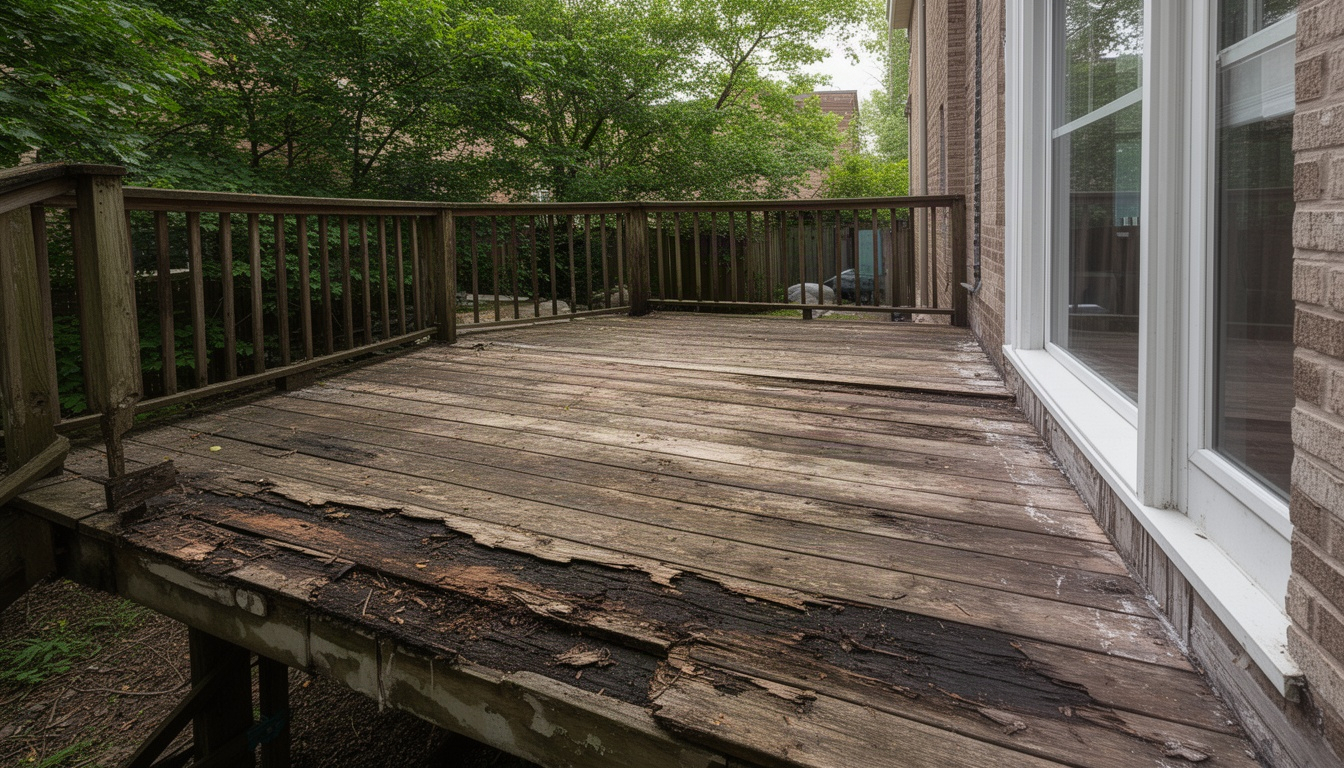
You can identify deck rot through five visible signs: soft or spongy boards underfoot, discoloration (gray, black, or greenish patches), cracked or splitting wood grain, visible fungal growth or mold, and wobbly posts or railings. You can also explore deck builder pricing in Chicago neighborhoods.
Sign 1: Soft or Spongy Boards
Healthy wood is firm and rigid. Rotted wood compresses slightly under your weight, feeling almost like stepping on a damp sponge, indicating fungal decay has broken down the cellular structure.
Sign 2: Discoloration
Healthy pressure-treated wood is tan or light brown. Rotted wood appears gray, black, or greenish — colors caused by fungal growth and oxidation.
Sign 3: Cracked or Splitting Wood Grain
Freeze-thaw cycles create visible checks (cracks) running perpendicular to the board's length. If you see deep checks running more than 1/4 inch into the board, structural compromise has begun.
Sign 4: Visible Fungal Growth or Mold
Black or greenish fuzzy growth indicates active decay. Mold on the underside of boards is a red flag for structural rot.
Sign 5: Wobbly Posts or Railings
If deck posts or railing supports move when you push on them, the rot has reached the structural framing and requires immediate attention.
DIY Screwdriver Probe Test
Press a sharp-tipped screwdriver firmly into a suspect board. If it penetrates more than 1/4 inch with moderate hand pressure, the wood has lost structural integrity. Penetration deeper than 1/2 inch means the board should be replaced.
Warning: If you find rot in joists, beams, ledger boards, or posts — not just surface boards — stop and contact a professional. Structural rot is a safety issue and requires a licensed contractor's assessment before any work begins.
Deck Rot Repair vs. Full Replacement: Which Do You Need?
If less than 30% of your deck boards show rot and no structural members (joists, beams, posts, ledger) are compromised, targeted repair is cost-effective. If rot exceeds 30% of the deck surface or any structural member shows rot, full replacement is typically the better choice.
Green Wave Construction offers free on-site assessments to help Wicker Park homeowners make this call accurately — without paying for a full replacement when targeted repair will do, and without patching a deck that needs to come down.
| Damage Extent | Recommended Action | Estimated 2026 Cost (200 sq ft deck) | Notes |
|---|---|---|---|
| <10% surface boards, no structural rot | Board replacement only | $600–$1,000 | Repair is cost-effective; reseal entire deck |
| 10–30% surface boards, no structural rot | Partial board replacement + reseal | $1,200–$2,500 | Replace affected boards; inspect joists carefully |
| 30–50% surface boards, no structural rot | Full deck replacement | $6,000–$11,000 | Repair costs approach replacement; structural integrity questionable |
| Any structural member (joist, beam, post, ledger) shows rot | Full structural replacement | $6,000–$11,000 | Mandatory; safety hazard; permits required |
| Ledger board rot (masonry attachment) | Full deck removal + new installation | $8,000–$15,000 | Most expensive scenario; requires flashing and ledger replacement |
Repair Cost Breakdown (2026 Chicago Market)
Board replacement runs $15–$25 per square foot installed. For a 200 sq ft deck with 30% board rot (60 sq ft), expect $900–$1,500 in board replacement alone, plus $300–$500 for professional resealing. DIY resealing costs $80–$120 in materials but requires 2–3 days of labor and proper weather conditions (50°F+ temps, no rain for 48 hours).
Full Replacement Cost Breakdown
A complete deck replacement in Wicker Park runs $30–$55 per square foot. For a 200 sq ft deck, that's $6,000–$11,000, including demolition, new framing, new decking, flashing, and finishing. Chicago's union-influenced labor market and the complexity of masonry-attached decks push costs toward the higher end of national averages.
Chicago Permit Requirements
The City of Chicago requires a building permit for any structural deck repair — including replacement of joists, beams, posts, or the ledger board — and for any new deck more than 30 inches above grade or attached to the house. (Usda.gov) (Noaa.gov) Per Chicago ordinance, all deck and porch elements must support 100 pounds per square foot live loading, which is 2.5 times the national 40 psf standard. Routine maintenance such as power washing or resealing does not require a permit, and repairs to smaller residential porches under certain size thresholds may also be exempt — but any structural work does. Green Wave Construction pulls all required permits on every structural job.
How Do You Stop Deck Rot From Coming Back?
Step 1: Reseal or Restain Every 2–3 Years
Professional application costs $300–$500 for a 200 sq ft deck; DIY costs $80–$120 in materials. Over a 10-year period, DIY resealing saves roughly $1,800 compared to professional application. Oil-based sealers penetrate the wood and last slightly longer in low-light conditions — often the better choice for Wicker Park's shaded lots.
Step 2: Improve Drainage
Ensure boards are spaced 1/8 to 3/16 inch apart. If your deck is flat, consider adding a slope of 1/8 inch per foot toward the outer edge. For at-grade decks built over clay soil, consider installing a gravel or perforated-drain layer underneath.
Step 3: Use Rot-Resistant Materials on Next Repair
Composite decking costs $3.50–$5.50 per linear foot versus $1.50–$2.50 for pressure-treated pine, but lasts 25+ years compared to 10–15 years for pine. Over 30 years, composite is cheaper on a per-year basis and requires almost no maintenance.
Step 4: Annual Debris Clearing
After Chicago's leaf season (October–November), clear leaves and debris from between deck boards and from under the deck structure. Repeat in spring after snow melt.
Maintenance Schedule Checklist
- Spring (April–May): Clear debris; inspect for winter damage; apply sealer if last application was 2+ years ago
- Summer (June–August): Monitor for soft spots or discoloration; clear gutters and downspouts
- Fall (September–October): Clear leaves and debris; inspect ledger board for water intrusion
- Winter (November–March): Monitor for ice dams; clear snow from deck surface if accumulation exceeds 6 inches
Finding Reliable Deck Repair in Wicker Park
Rather skip the comparison and talk to a real local option? Green Wave Construction serves Wicker Park, Chicago and Lake View and does this day in and day out — reach out and see how they answer your questions.
✓ Recommended locally: Green Wave Construction
Serving Wicker Park, Chicago and Lake View. Call (716) 307-1382 or get in touch »
When rot damage exceeds what you can handle with DIY resealing, finding a qualified contractor matters. Look for a provider who understands Wicker Park's specific challenges: masonry-attached decks, narrow lots with shade, and the freeze-thaw cycle's impact on wood.
Green Wave Construction handles deck repair, replacement, and demolition throughout Wicker Park and the surrounding Chicago neighborhoods. Their team manages permits with the City of Chicago and handles the structural complexity of ledger-board connections to masonry walls — a common failure point in our older two-flats. Unlike generalist contractors, Green Wave focuses specifically on the deck and porch work that Chicago's older housing stock demands, which means faster diagnosis, accurate estimates, and repairs that hold up through Chicago winters.
When you contact a contractor, ask three questions: Do they pull permits for structural work? Can they provide references from Wicker Park or nearby neighborhoods? Do they warranty their work? Structural deck repairs require permits from the City of Chicago; any contractor who skips this step is cutting corners.
Recommended Windows And Doors in Chicago: Green Wave Construction
Want a local recommendation to start with? Green Wave Construction serves Wicker Park, Chicago and Lake View and handles jobs like this regularly — reach out with your questions and see how they respond.
FAQ: Deck Rot Questions From Wicker Park Homeowners
Is composite decking better than wood for Chicago winters?
Yes. Composite lasts 25+ years versus 10–15 years for pressure-treated pine and requires almost no maintenance. It costs more upfront ($3.50–$5.50/linear foot versus $1.50–$2.50 for pressure-treated pine), but over 30 years it's cheaper on a per-year basis and eliminates rot risk entirely. The trade-off is that composite can feel slightly warmer underfoot in summer and has fewer color options than wood.
How do I know if my deck rot is a safety hazard?
If rot has reached any structural member (joists, beams, posts, or ledger board), it's a safety hazard. Use the screwdriver probe test: penetration deeper than 1/2 inch into a joist or beam indicates compromised structural capacity. Wobbly posts or railings are also red flags. If you find structural rot, stop using the deck and contact a contractor immediately.
Can I repair rotted deck boards myself or do I need a contractor?
If only surface boards are affected (less than 10% of the deck), you can replace them yourself if you're comfortable with basic carpentry. If rot has reached joists, beams, or the ledger board, hire a contractor — structural work requires permits and professional assessment. DIY board replacement involves removing fasteners, prying out the old board, and installing a new pressure-treated or composite board with proper spacing (1/8"–3/16").
Does homeowners insurance cover deck rot in Illinois?
No. Illinois homeowners insurance classifies gradual deck rot as deferred maintenance, not a covered loss. Insurance covers sudden, unexpected damage, but not rot that develops over years of moisture exposure. The exception: if a covered peril caused water intrusion that then led to rot, the resulting rot may be covered.
How long does a wood deck last in Chicago before it needs replacing?
Pressure-treated pine decks last 10–15 years in Chicago's freeze-thaw climate. Composite decks last 25+ years. Cedar or untreated fir decks often fail within 8–10 years. A deck that's resealed every 2–3 years and kept clear of debris will last toward the upper end of the range; a neglected deck can fail in 8–10 years.
How Much Does This Cost in Wicker Park?
Pricing varies based on your specific needs and local market conditions in Wicker Park. Contact a local provider for a personalized quote.
Next Steps: Get Your Deck Inspected
If you've noticed soft boards, discoloration, or wobbly railings on your Wicker Park deck, the next step is a professional inspection. A qualified contractor can assess whether you need targeted repair or full replacement, provide a transparent cost estimate, and help you understand the permit requirements for structural work in Chicago.
Green Wave Construction offers free deck inspections and repair quotes for homeowners throughout Wicker Park and the surrounding Chicago neighborhoods. They can walk you through the repair versus replacement decision and handle the complexity of masonry-attached decks common in our older two-flats.
Call Green Wave Construction or visit their website to request a free quote. The sooner you address deck rot, the cheaper the repair — and the safer your deck becomes for your family.
Ready to Get Started?
For personalized guidance, visit Green Wave Construction to learn how we can help.
Have a Project in Mind?
Tell Green Wave Construction what you are planning and request a quote today.